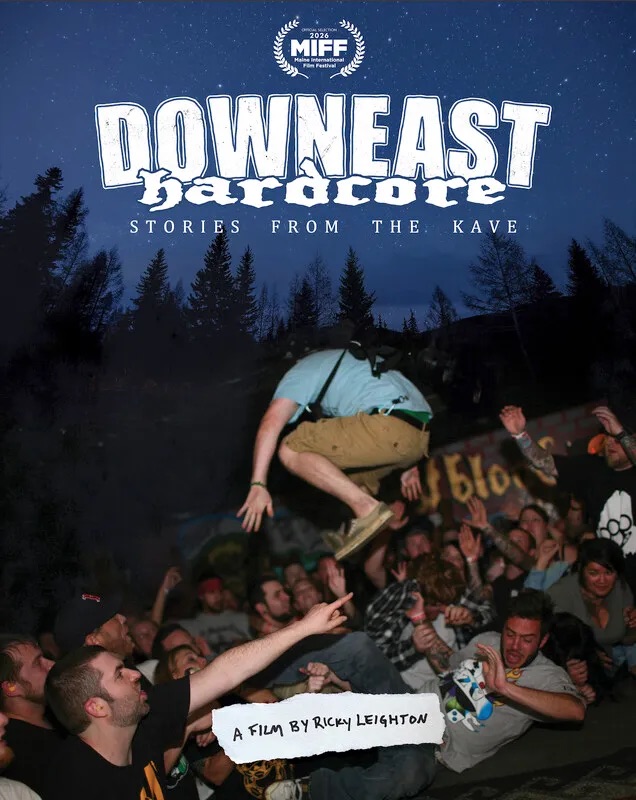
Kids of The Kave - An interview with Ricky Leighton on the story of "Downeast Hardcore"
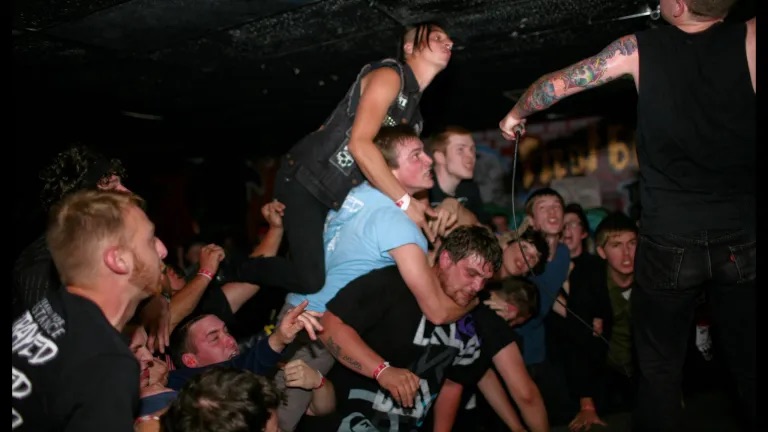
Photos courtesy of Leighton Video
Written by F. J. Gallagher
Ricky Leighton may not have considered himself a "Kave kid," but the DIY ethic that fueled New England's most unlikely hardcore punk scene gave him the push to document an important time and place in the lives of Maine youth.
The documentary, "Downeast Hardcore: Stories from the Kave," is about as local as a film can get. Leighton and his team scraped together funding from the Maine Community Foundation, the New Surrey Theater & Performing Arts School, and crowd-sourcing efforts. Despite growing cuts to the nonprofit sector in many of the state's town budgets, the community came together to help the filmmaker produce one of the most original music documentaries in Maine history.
We spoke with Leighton ahead of the film's screening at Geno's Rock Club on Saturday, Aug. 8, to talk about creating the documentary, whether DIY spaces like The Kave can exist today, and how to get older folks to understand the hardcore music scene.

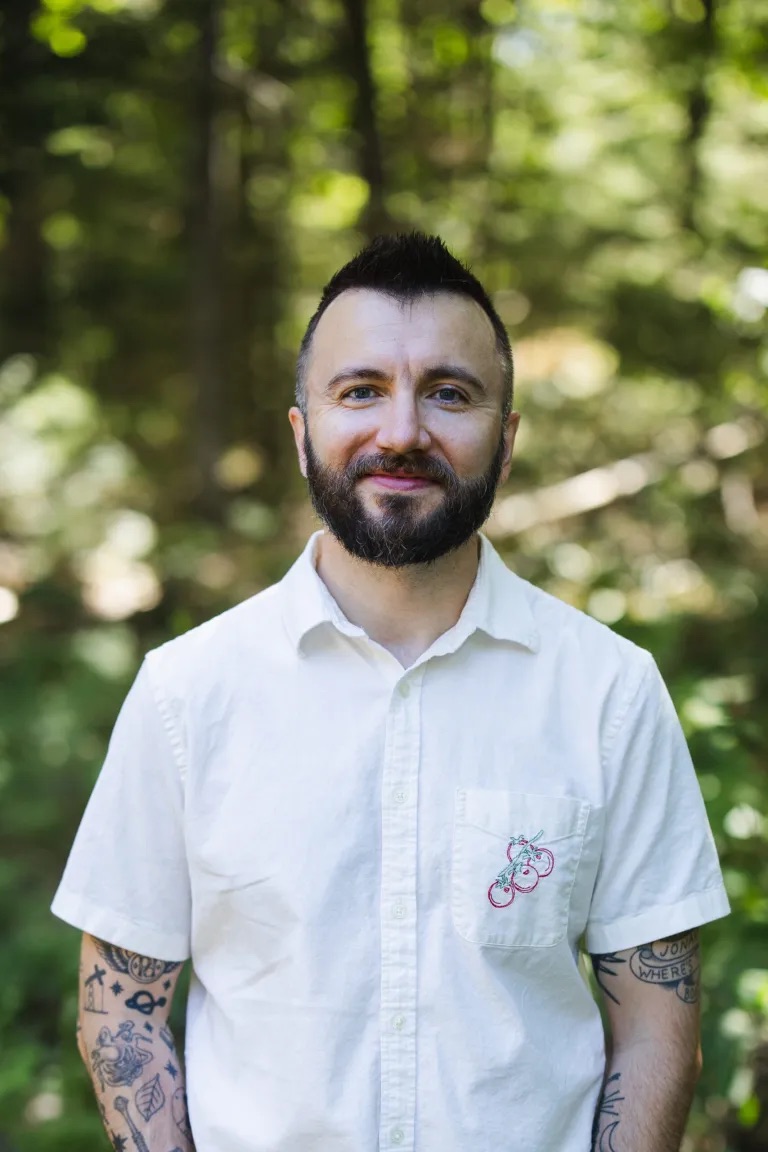
Director Ricky Leighton spoke with us about his newest documentary "Downeast Hardcore - Stories from the Kave." Photo courtesy of Leighton Video
Maine Coast Life: What's the film about?
Ricky Leighton: The film is about this woman, Kathy “Kave” Findlay. She opened a music venue in the woods of Bucksport, Maine. From the early 2000s to the mid-2010s, it became a safe haven for all the kids in the area — rural Maine teenagers, [some] kids drove down from as far as from Millinocket to go to these shows. She not only booked well-known bands and famous acts to play there, but she also allowed local groups to open for them. As a result, she created what they call “Kave kid culture,” where they were taught how to put on events themselves, how to perform for others, how to write music, and how to really create community and care for space.
MCL: How did the film emerge? What's your connection to The Kave and that whole scene back then?
Leighton: Yeah, so I grew up in the area on the Blue Hill Peninsula. I had gone to The Kave a couple times. But I graduated, moved out of state, went to college, to film school, and a decade later, decided to move back home, and had really pursued a career in documentary filmmaking. And a friend of mine had brought up the idea of The Kave and Kathy as being a good subject for film. I kind of knew right away that was the right fit for me. I was into the music and a little bit part of the scene. But I think the thing that I really had ownership over in terms of the story was being an angsty Maine teenager. I don't consider myself a Kave kid, because I only went there a few times, but I could totally relate to that feeling of being isolated and needing a place to go.
MCL: Are there any similarities between shooting, editing, and screening a sort of niche documentary like this, and the whole scene that was going on at The Kave?
Leighton: I had done a short documentary prior to this project called “Candlepin,” and it was about candlepin bowling in Maine. I've gravitated toward Maine-based stories. There are things that I'm usually aware of or was a part of. I grew up bowling, and I also grew up listening to some of the music. So I had a personal connection.
But when you explore subjects like this, you have to become the resident expert in that field to tell the story adequately. I think what I've learned about those things, and the sense of community, is that all of these stories that — especially the ones I like to target — they have a loyal fan base of people who will support the film, people who will show up who are anticipating this project. So, as a result, there's a lot of heavy expectations, right? You have to do justice to their story and that's always the number one priority. I underestimated how big the loyal fan base was. It was way bigger than I could have ever imagined, but I knew that there was a good group of people here that would support the project if we pursued it.
MCL: Could something like The Kave happen today?
Ricky Leighton: Yeah, absolutely. What's amazing is, if you look at Kathy's story, there’s this lack of resources. She had the support of people who would show up, but she was charging $10 a ticket, if that. And often kids were so poor that they would just ask if they could donate a can of cat food to go to the local shelter or if they could just clean up afterwards as admission to the show. So she wasn't making money from these shows and she addresses that idea of, like, what she had to do to make it happen
And there's a level of personal sacrifice there for sure. Kathy is a teacher. She cares for kids innately, that's just in her. So I think that's a secret ingredient. We're screening at Geno's this weekend, and they've done a really cool job of trying to embrace that DIY feeling, the home-built shows. The Maine hardcore scene is alive and well and doing just as well as it was doing in the early 2000s.
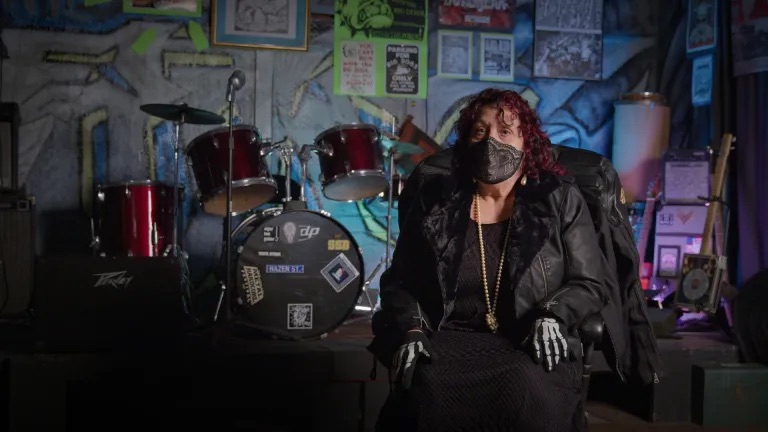
Kathy Findlay created a safe haven for hardcore fans and disenfranchised youth. Photo courtesy of Leighton Video
MCL: You’ve got a screening at Geno's coming up on Saturday. Is there a connection between Geno's, this legendary punk club that’s been around since the ‘80s, and The Kave?
Leighton: Yeah, what's amazing is that a lot of the people who are involved with The Kave — and who are helping me out with the Geno’s screening — they're concert promoters or they're in bands. So they're doing all the heavy lifting for me. Normally, I would be booking all this stuff myself and finding venues, and they just took it and ran with it, and it's a product of what Kathy has built.
You get Corey Jones and Chris Linkovich, Cheap Life Records, Jessica Harvey — who's a producer on the film — she's moderating the Q&A at Geno’s. These are kids that were ingrained and raised in Kathy's Kave culture, and they're out there in the real world doing things now. They're doing shows at Geno's all the time. So it was a no-brainer. They're like, “We're gonna do it here. We're going to have bands play. This is going to be great.” And it just seemed very natural.
MCL: So the program at Geno's Saturday Night is not just the film? What's the program going to be there on Saturday night?
Leighton: Yeah, we have no idea how it's gonna turn out. I don't know if anyone's ever done a documentary film screening with a Q&A followed by a live hardcore show.
MCL: I imagine there'll be a lot of people who see this film that don't know anything about the DIY or hardcore scene, so if somebody with no connection to the scene at all sees the film, what's the one thing you'd like them to take away from it?
Leighton: Yeah, we premiered in Waterville [at the Maine International Film Festival], and the benefit of a film festival is that you get a lot of people in the seats who aren't just there necessarily because of your film. They're there to check out film in general. So you get a lot of new eyes and people that aren't a part of the scene.
I had several people approach me afterwards, older folks, and this is a completely new story to them. They came up to me and they said, “I don't care for the music. It's not my thing, but I understand.” And I think that's the goal for the film. The film is for everybody. It's not just for hardcore fans.
Of course, we got stuff in there for [hardcore fans]. There's some Easter eggs and stuff, and the music's heavier, but it's a universal story of the difference that one person can make in people's lives and how we're all capable of being a part of that community. In a perfect world, if somebody can walk out of the theater after seeing this film and giving us a chance [to tell our story], ... they'll understand. Not just with the hardcore music, but when they see the youth, and they're out involved in something that looks a little bit different or weird or strange. To not judge a book by its cover, but to understand that it comes in different shapes and sizes.
Tickets to the film screening and the subsequent Q&A and live show on Saturday, Aug. 8, are available on Geno's Rock Club's website.