
"Listening First" - An interview with M.C. Taylor (aka Hiss Golden Messenger)
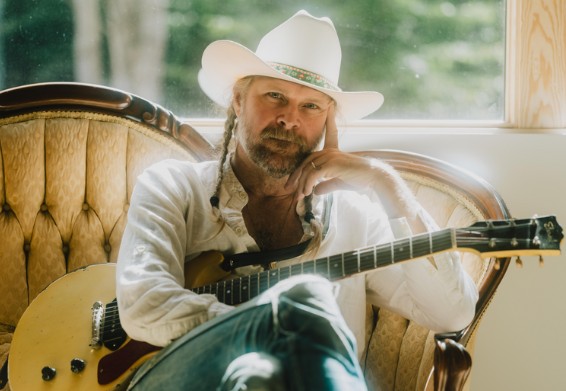
Photo courtesy of Chrysalis Records
Written by Chris Hislop
There is something uniquely grounding about the way M.C. Taylor’s (aka Hiss Golden Messenger) songs resonate inside One Longfellow Square in Portland. If you’ve seen him there, you know the feeling. If you haven’t, you'll get another chance (or, really, two) on Aug. 18 and 19, marking the 11th consecutive year of these special performances.
Now firmly established as a midsummer tradition, Hiss Golden Messenger's two-night solo stand offers a rare chance to strip back the studio lushness and heavy-grooving full-band arrangements to expose the quiet, beating heart of the music. In a room known for its intimate warmth and listening-first atmosphere, Taylor’s songs of resilience, faith, and radical hope find their most natural home. And who couldn’t use a dose of all that?
Let’s hear from the man himself about what these shows mean to him, the dynamics of shifting from a full-band setting to a solo arrangement, thoughts on Hiss Golden Messenger’s new record, “I’m People,” and much more.

*
Since this feature is in support of your impending solo gigs at One Longfellow Square, I’m going to start by leaning in heavily there… I love those shows and have been to a few of them in the past. The venue has become a regular, near-sacred stop for your solo acoustic shows. What is it about that room and the Portland audience that makes you want to return and strip these songs back to their bare bones?
Well, I’ve been married to a Mainer for a long time. Originally, One Longfellow started as a convenient place to do a show, maybe just a one-off or something while I was on vacation in Maine with my family. I had no plan for it to become a regular thing. But the longer I did it, the more I started to understand the community around One Longfellow, and the more I sort of built it into my summer. People listen there. It’s bare bones, and can hold onto whatever vibe you want to put into it. I’m very thankful that people continue to come back. There have been discussions over the years about moving it to a different space, but I’ve always said, “Nah, I think it’s good,” because it just feels like a comforting place, at this point.
Playing solo in an intimate listening room requires a completely different kind of presence than leading a full ensemble. How does the quiet atmosphere of OLS — or any of your solo shows, for that matter — shift the way you interpret older material or test out newer songs?
Having a quiet room definitely changes the way I approach songs. Obviously, it allows me to play quieter myself, which is a huge luxury and just allows for much more dynamic range throughout the night overall. But I think having a quiet listening room also gives me more understanding about how a song might work, like whether it’s hitting in the room for the intended reasons.
Over the years, you’ve built a strong connection with the New England region. Does traveling up through coastal Maine invoke a specific headspace or songwriting mood for you?
Of course. And I have countless memories of being up there with my wife, Abby, and my kids starting when they were tiny. It’s a part of my life, I feel fortunate to say, which makes Maine even more special to me. It’s more than a vacation destination; it’s like a spiritual place.
Besides these shows and visiting with family, what do you look forward to when you come up and visit Maine every summer? Any specific cravings as far as cuisine is concerned?
So much changes from year to year, but I always try to hit Enterprise Records if I can. I remember when he was on Congress Street decades ago. My wife and I will happily sit on the deck at Terlingua for hours. Oysters at Island Creek Oysters on Washington Ave. Red’s Dairy Freeze. Taking a pizza up to the Eastern Prom at sunset and having a picnic with my family. Swimming at Higgins Beach. Coffee and a biscuit at Tandem [Coffee Roasters]. Bagels at Scratch [Baking Co.] or Rose Foods. Riding bikes around Peak’s Island. I realize this stuff is probably pretty basic, but it’s also perfect.
OK, let’s shift to the latest Hiss record for a few. You wrote parts of “I'm People” across very distinct landscapes — from Bolinas [Calif.], to a Santa Fe motel room and the North Carolina Piedmont. How did moving through those radically different environments shape the geography and mood of these songs?
I think you’d have to just go to those places and experience what it feels like and how it changes your perspective, at least momentarily. As for Bolinas and Santa Fe, it was some combination of convenience, nostalgia, and wanting to be around those landscapes. I grew up in California, and they’re both familiar in different ways. The West.
The album deals heavily with themes of aging, fatherhood, solitude, heartbreak, and finding “radical hope” in a turbulent world. Was there a specific moment or realization during writing where the title “I'm People” crystallized what you were trying to say?
When I actually went into Dreamland [Recording Studios in New York] to start recording, the group of songs had been winnowed down to a point that they were more or less record length, with some outtakes, so I suppose at that point I would’ve been thinking about them as a group that was sort of all pointed in the same direction. When I was naming the record, “I’m People” just kept coming up as a concise, not overly serious way to name all of the different themes on the record.
You recorded at Dreamland, a decommissioned church outside Woodstock, New York. Did the acoustics and sanctuary atmosphere of that physical space imprint itself on the spirit or sound of the record?
I think so. I feel like you can hear it. It’s sort of a holy-sounding record. Not religious, but kind of filled with spirit. I think part of what I really love about the record is that particular aspect, like the overall sound of it.
I personally loved “Quietly Blowing It” [2021]. What did you learn through the process of bringing that record to life that carried through to “I’m People.” In some ways it feels like the two could be a series of sorts. Continuous volumes, if you will…
It’s interesting that you say that. I can sort of see it, although I’m not sure I could put my finger on why. Maybe the shades of vulnerability on both records are similar. Because it was a record made during the pandemic, “Quietly Blowing It” has always inhabited a different place in my brain, away from some of my other records. But I’ve realized over the past few years that people are really attached to that one, and that makes me happy.
What led you to begin the record by fading in? I found that unique, as it’s typically an effect that calls out a tune versus calling one in.
We just loved the way it makes you feel like you’re gradually entering into a space.
You co-produced this record with Josh Kaufman [Josh Ritter, The National]. He’s been a pretty busy dude for quite some time now. What did his perspective bring to the arrangements, and how did your producer dynamic push the sound forward?
I definitely think of Josh as the main producer on this record. I sort of have my arms around what Hiss Golden Messenger is, but it’s hard for me to be more quote-unquote objective about certain creative things. Josh knows enough about me and my music to push me into places that highlight whatever it is that Hiss Golden Messenger is about. He hears it differently than me, and I need that.
The record features a stacked lineup of collaborators — Bruce Hornsby, Sam Beam, Sara Watkins, Marcus King, and members of Dawes, among others. How do you decide who to invite into the circle, and how do you leave space for their distinct musical voices without losing the core Hiss identity?
I mean, it sort of just had to do with who was around, who came to mind right as we were working on a specific track, that kind of thing. It wasn’t quite as planned-out as you’d think. It was more like, "Hey, I think Amy Helm is like 20 minutes away; should we have her come put some harmonies down?" Or running into Bruce Hornsby at a festival and asking him, "Hey Bruce, could I get you to play some piano on the new Hiss record?" It was all pretty organic. And everybody added their thing to the weave was really beautifully.
The lead single, “In the Middle of It,” feels like a quintessential road-trip reflection through desert highways and Art Bell radio waves. Could you talk about the origins of that track?
Yeah, sort of a “Running Down a Dream” type thing. Like flying. I grew up playing in bands, like I started driving all over the country at like 18, so I’ve been up and down these highways. I suppose “In the Middle of It” is some kind of meditation on the way life changes on a dime. Unpredictable.
In general, why music? Why do you seek it? Why do you create it?
Because I love it so much.
Having recorded such a rich, communal album with live-in-the-room energy, what is the experience like stripping those new arrangements down for your solo shows this summer?
We’re about to find out! Honestly, I’ve been playing a lot of the “I’m People” songs for a while. I know I played some last summer at One Longfellow. When I was writing them, I was trying to keep my eye on whether they would hold up with me just playing them alone. It’s one thing to make a song work in the studio, and sometimes another to make it work live on a stage in front of people.
Do you have favorite songs from your catalog that are “musts” on your solo setlist?
This year it’s probably newer stuff. And I’ve been writing a lot, so you never know. There may even be new new stuff.
Appreciate the time, M.C.!
Likewise, Chris!
*
For further information and to scoop one of the few remaining tickets to either show, head on over to www.onelongfellowsquare.com.