
Maine is Dead - An Interview with A Band Beyond Description
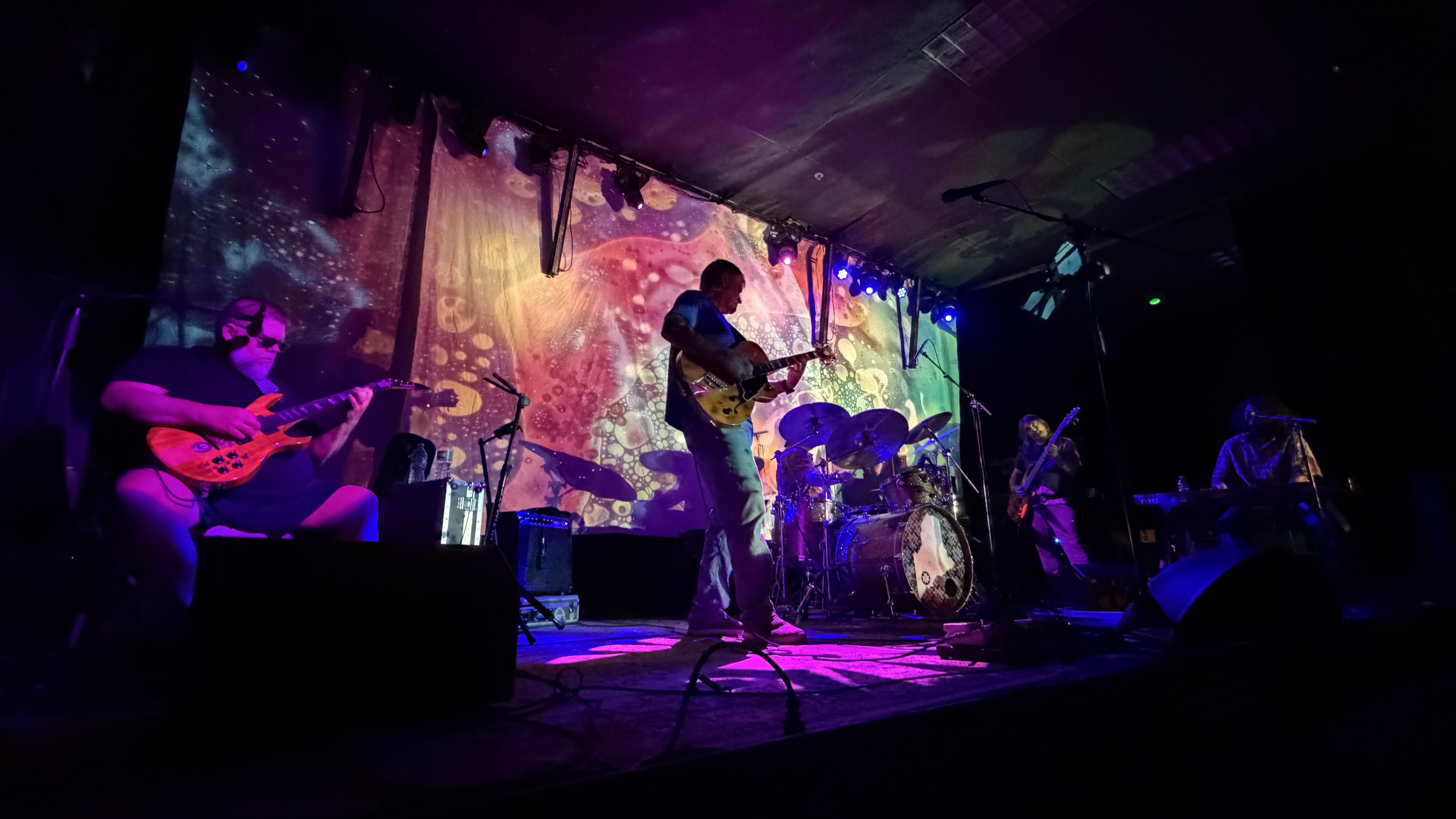
Maine is dead... At least, in a grateful kind of way.
A Band Beyond Description is a Pine State tribute to the legendary San Francisco musical nomads. They've got a residency at the Portland House of Music every Wednesday through September. Maine Coast Life met up with the members in the green room of the venue for a chat about the Grateful Dead's impact in Maine and how the band keeps the songs fresh after over 20 years of performing.
How did you all get together?

Jason Phelps (lead guitar/vocals): Well, the first day of high school, I was walking through the parking lot, and there was a long-hair dude sitting on the back steps, smoking… something, and he looked pretty cool. So I walked over and introduced myself. And [that was] Chris and we became friends at that time, and over the years we got to play some music together early on and then not for a very long time and then back together again. So it's been very cool to be reunited.
Did you guys bond over the Dead immediately when you first met each other?
Phelps: Yeah, Dead were very popular in our universes at that time.
Chris Dow (drums, vocals): Dead-related. Yeah, and Dead-related music.
Phelps: Yeah, totally. Because, of course, they were still playing. So we were going to see that regularly.
Chris, you and I were talking earlier, and this was late '80s?
Dow: I started mid '80s.
What was the state of the Grateful Dead at that time in the late '80s?
Dow: Well, we were talking about mid '80s before “In The Dark” album, and like '87, and they got really, really popular finally. Finally had a top 40 hit and stuff. So we started seeing them a few years before that. And it was still very much Deadheads. You know, it wasn't a big sold-out scene. Definitely a smaller scene. It was palatable. It's no violence, nothing was stupid. Anyway, the more famous they got, the more people they got, and, yeah, more stupid happens [laughs]. I don't know. It got pretty crazy for a while.
Was there a big Maine Dead following at the time? Because when I think of music in the mid to late '80s, and even on a national level, you had the Debbie Gibson's of the world and all that pop stuff. But that was also kind of when punk and metal and new wave and all that stuff was getting popular. Did you guys feel like you were on an island, or was the Grateful Dead somewhat popular up here?
Phelps: I think they were definitely popular because they were active and playing. But I think people were listening to all kinds of stuff, though. I went to high school in Cumberland. And so in Cumberland, we met lots of people. I met a lot of people who were not like me, people from Cumberland Foreside, and people that listened to different things. And people were very open to pretty much most music. So people were just into music in our world. Yeah, but Grateful Dead was definitely something everybody bonded.
Jeff Irish (rhythm guitar/vocals): You know, the Dead loved playing in Maine. They came to Maine '84, '85, '86, three years in a row. There were definitely a lot of folks from our local community that were going up, all those Portland shows.
Greg Goodwin (bass): Yeah, I think in “In The Dark,” that's when they really blew up, and it kind of started getting sort of stupid to go into the shows, you know … you could tell, it was just … the wave had sort of changed. Crowds were a lot younger, and there was a shift musically, too.
Phelps: Bigger venues as well.
Goodwin: Bigger venues, the music scene as a whole. There was a shift with Ticketmaster and … buying tickets changed. So, you know, we … wait for the tickets to come out in mail order. I mean, you know, that was like the norm. By the '90s, it had changed. There were glimmers of good shows and stuff, but I think for the most part, everybody here feels like it changed.
You guys had mentioned “In The Dark” a couple of times now. What about that album was so special?
Phelps: That was the first number one hit with “Touch of Grey” and a video, and that just brought an enormous new wave of fans. And they were having kind of a Renaissance. Jerry Garcia had his coma in ‘86. It didn't play for a good long time, and coming out of that, they were just a way better band. And the shows in the ‘87 and ‘88, I mean, they were on fire a lot of the time. It was prime time to be seeing them. And then they just exploded with “Touch of Grey” and then the video for “Hell in a Bucket” and all that stuff. I remember watching them on the Today Show as a kid. I was like, “Whoa, this is really weird.”
Irish: You could blame it somewhat on MTV, with the whole video craze. So they jumped on that bandwagon.
Goodwin: And they finally made good money. So that was cool [laughs].
Finally. After, what, probably 22 years at that point or whatever?
Irish: One of the funniest interviews I’ve ever seen with Jerry and Bob [Weir] was, somebody asked them, “Well, you guys finally made it,” and they just looked at each other and were like, “Oh, hey, great!
So going back to you guys, how did you officially get together and start playing shows, and what were some of those early shows like?
Phelps: Well, even in high school, there were a variety of bands that were kind of Grateful Dead-adjacent. We were all playing music together. And then several of us have gone on to be professional musicians right through our lifetime. I was in a bluegrass band called “The Jerks of Grass” and playing a ton of shows around here. We did pretty well for ourselves. And Chris was in Gypsy Tailwind, but he played a lot of music around. And we’d been in Elderberry Jam before that. And so we definitely just kept doing our thing, that's for sure. How long has it been now that we've been back together kind of playing?
Dow: It’s been like eight years. A Band Beyond Description has been around since 2000, and we’ve been in the Portland scene since 2001. This is the fourth … what you call … amalgamation? You know, people in the band … babies are born, life takes over. Everybody grows. I'm the only one that’s been there since probably the second, third week of the band. So the band has kind of been coming and going, and I’m just sitting on my drum set, you know. It's great, the people that we've had over the years.
Phelps: For example, Kale is a good friend of ours that we play a lot of shows together. He's not currently a regular member of the band. Justin Maxwell is currently our full-time keyboard player, who is a phenomenal player, and he just had something else going on tonight. So it's just one of the cool things about this music. It's a lot like playing jazz or bluegrass where people know the repertoire. You don't rehearse; you show up, and you play the songs, and you can just do it. And that's really exciting to do that. So it's super fun to play with Kale tonight.
It's interesting to see so many dedicated Dead projects, especially up here, but even in spots like Newmarket, New Hampshire; Portsmouth, New Hampshire; Burlington [Vermont].
Phelps: People are just starving for this music, and then people really support it. Our fans really support the music and it's been really fantastic.
So going back to what Jeff had mentioned earlier, to what do you guys attribute the interest in the Dead, specifically in New England? Do you see an association between those two?
Dow: Oh, the Dead and skiing? [laughs] No, I don't know. Rural. I have no idea, because they're incredibly Americana, you know? Like every form of American music.
Irish: They played so many different venues all over New England. They’ve touched every state, many places. So I think it's really a product of that. And people going and being part of the experience.
Dow: In every city and town, there’s Dead bands. For 40 years, there was just one.
Goodwin: Now there are 10, instead of one!
Dow: A Band Beyond Description is a lyric of a Grateful Dead song. So Dead bands in America usually named themselves after something from the Grateful Dead universe — a lyric, or a piece of a picture or something. So if you go to a different town and you see A Band Beyond Description, you're going to know it's a Dead band. It's really fun. It's a Deadhead thing.
Phelps: Everybody has their different take on it. Even in the kind of bigger sphere of bands like Joe Russo’s Almost Dead, they're doing their whole own thing on it. They're really rocking and rolling it up, and I think that's really cool. And a lot of people are really into that. I would not call us purists in any way, but I do think that there is an aspect of the music that we touch upon that some other bands do not touch upon that means a lot to people, that's very endearing to them. I don't know exactly what that is. There are some really subtle little details that, especially for the guitar stuff, I try to always get in there because they trigger those memories for people. And that's what's happening here. They're not even listening to us play. It's just kind of there, and it's just happening, and it's a really cool feeling.
So just to expand on that, too, with all due respect to the other Dead tribute bands that are around here, what does make you guys unique?
Phelps: I don't know. I just think we have our own approach to it. And I think we're adventurous and respectful at the same time, you know?
Goodwin: I feel like we play without a net, man! We really don't know what we're going to do next, right? And so we're like on stage, guitars in hand, there’s no setlist. I would use the term "winging it" loosely, but we are. We're kind of winging it in a way like we're supposed to. And that's kind of the way that the Dead would do it, too. I think that's more where the approach is.
Phelps: And really, we've all been playing so long that I don't think any of us are worried about making a mistake. They're not in my universe. And everybody's supportive, and if you can go ahead, you can make a horrible clam. It's going to be okay, nobody cares, because [the Dead] did it all the time, and they were really good at it. But that's exploration and improvisation and trying to do new things. That's what it takes. You're going to burn a few fingertips sometimes. But that's all right.
Jason, you had mentioned Joe Russo's Half Dead. Do you guys have a particular interest in certain characteristics of certain songs? Obviously, Joe Russo is a little bit more of the rocking side, but is there anything that appeals to you guys specifically in terms of the song selections or what you guys pitched during practice?
Irish: Practice?
[laughs] Oh, sorry. Forgive me for making assumptions.
Phelps: I would say we kind of tend towards this '70s, Billy [Kreutzmann] on the drums kind of thing. We're more like a jazz ensemble than a rock band. I think it's our approach to what we're doing with the Dead. And the Dead [crossed genres] too. In the '80s, they were a rock band.
Goodwin: I think, too, when we start talking about new songs or just songs in general, we all like what we like. Meaning, if we mention a song, it's like we reference an era.
Irish: You could be talking about these six or seven different variations of the same songs.
Goodwin: There’s different keyboards. I mean, there's a whole different approach.
Phelps: The other thing that's cool about this, man, is we don't play songs we don't like. Nobody has to play a song they don't like, which I think is very fair. You can say no, but you need to come up with a song, though.
Oh, that's fair. So in addition to the rules of “no practicing,” there's also [the rule that] if you veto a song, you have to come up with another one. I like that philosophy. So for you guys personally, how do you guys keep the songs fresh?
Phelps: Chris is the mood center, man. I think we go out of our way to play these songs wildly different. A lot like they did, too. Or there's also, “Hey, check this out.” We'll send around a link to a really cool version of something on the show and just kind of listen to it and just let it absorb into your pool of licks and phrases and things that they do.
So you guys will actively go into their concert catalog and research the interpretations.
Dow: Yeah. We have to know which year because in '72 there might be a different chord progression in the chorus area than in '74.
Goodwin: The speed they play the songs is everything. So our drummer here … that's pretty much, you know … if we start off slow, it's going to be like that. So you know there's a slow version of “Friend of the Devil” and there's the fast version of “Friend of the Devil.”
What's the one Dead song that you wish you had written?
Irish: “The Greatest Story Ever Told"
Phelps: “It Must Have Been the Roses”
Dow: “Cumberland Blues”
Goodwin: I mean, I have two: “Bird Song” and “Brokedown Palace.”