
Music from the history books — an evening at Mechanic's Hall
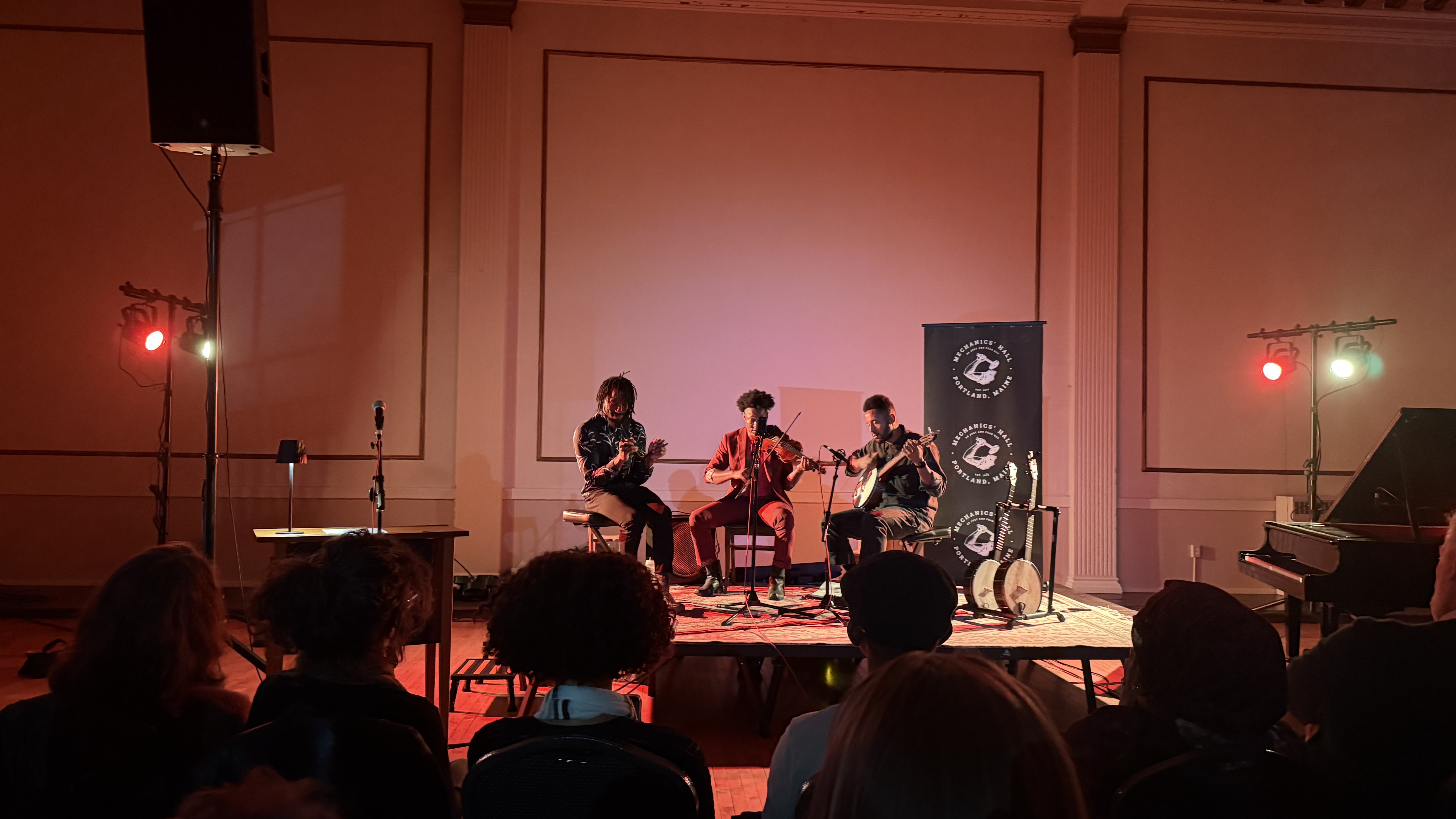
Photo by Austin Sorette
The greatest gift of new adventures is the opportunity to be humbled. A loyal fan of recent Maine transplant Kafari recommended a show at Mechanic's Hall in Portland in which the pianist/beatmaker/rhythm bones player shared the stage with violinist B.E. Farrow and banjoist Michael Kebede. Unfamiliar with both artist and venue, I couldn't wait to thrust myself into the discomfort.
The main room of Mechanic's Hall is massive. The spacious suite and high ceilings showcased its hollow acoustics before the artists even took the stage. The audience's footsteps echoed around the chamber, no matter how soft their shoes were.
The trio took the stage and politely took their seats. Each song they performed was interwoven with a history lesson. Farrow and Kebede, both veracious historians, spoke about their research into the lineage of Black music predating the jazz explosion in the early 20th century.
"It was interesting to learn that the banjo actually comes from Africa," Kebede said, twisting the tuning pegs on his instrument. "It was brought to America from Irish immigrants."

Farrow said the inspiration for some of his songs stemmed from current sociopolitical issues and reflections on past history. The opening song of the set was a traditional tune called "Roaring River," a composition written in the original 1853 memoir, "12 Years a Slave." Another tune was inspired by Farrow's participation in a protest supporting the Bethesda African Cemetery Coalition, an organization fighting to preserve African American cemeteries in Maryland from being literally dug up to build infrastructure. Ironically, Farrow mentioned that one of the proposed developments was for low-income housing.
Meanwhile, Kafari sat smiling, engulfed in the room's energy. His hardwood clappers rested in his hands, coming to life only during the performance, including a solo effort by the musician. During the first set, Kafari took time to introduce the percussion instrument and demonstrate how to play it. His execution was effortless; his instruction was clear and concise. However, it was probably for the best that the audience couldn't play along; the flow of this beautiful performance would have been stunted with asynchronous clapping and clattering like an elementary school student learning to tap dance.
Even as an open-minded white audience member, it's hard not to feel uncomfortable about the seemingly infinite discrimination and bigotry brought on by our ancestors, who enslaved other races to build the country in their image. But the three multi-instrumentalists fostered the most welcoming, inviting protest atmosphere. The abrasive approach pioneered by artists like Public Enemy and Kendrick Lamar was non-existent. All three guys spoke gently, smiled throughout the set, and engaged the audience with conversation rather than a lecture.
Despite the sobering reality of their history lessons, the guys know how to have fun. Farrow and Kebede joked about the chairs they sat in. Farrow prefaced songs in which he projected his vocals with an anecdote about his "loud" voice being fostered while playing on his middle school football team before he made the logical jump to musical theater. Kebede introduced one song as a tribute to his partner and soulmate.
Everything about the evening was warm and inviting, which is truly a gift only appreciated if you come into it cold.