
REVIEW - How “Heart of Duckness” makes colonialism fun
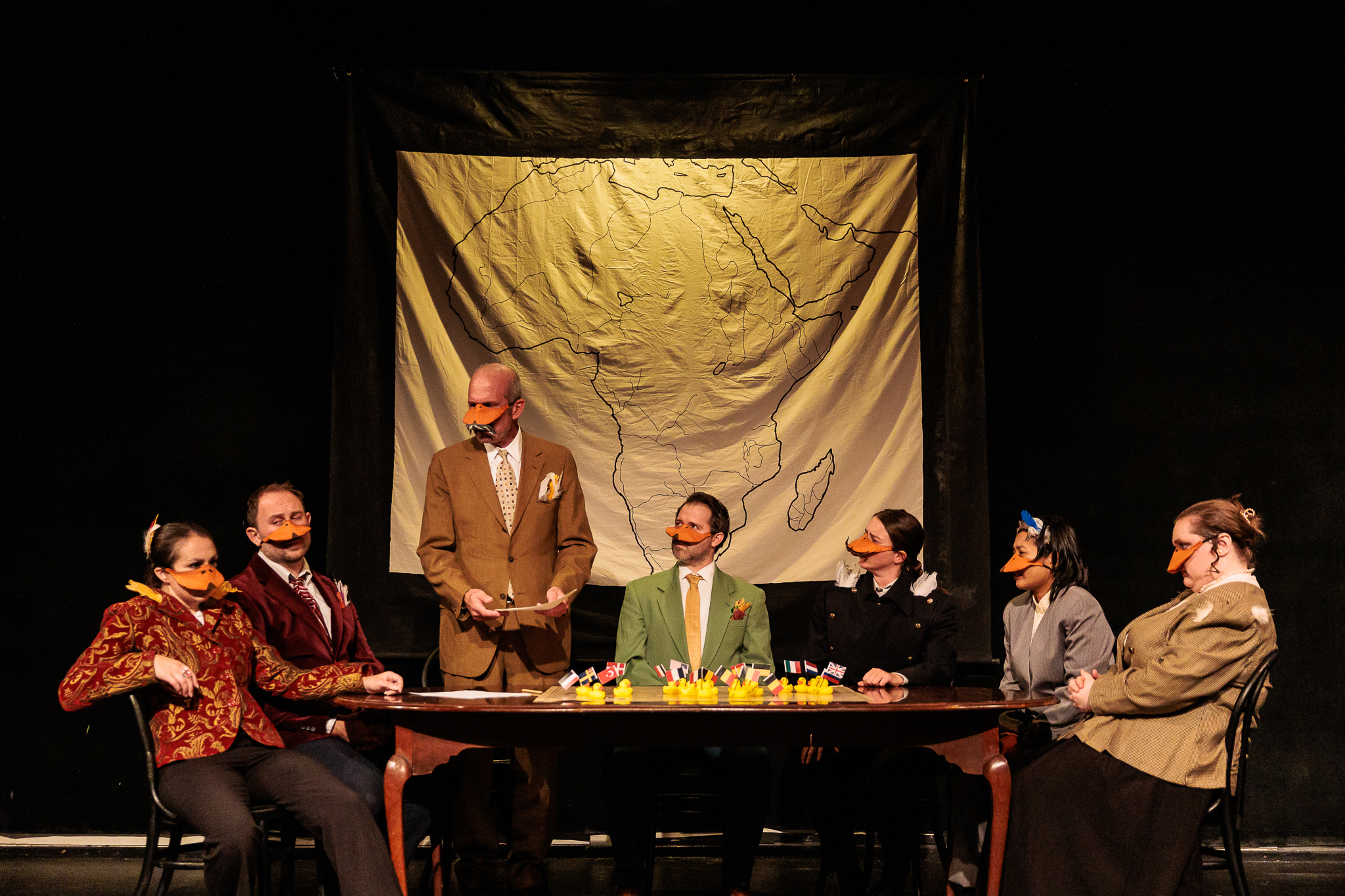
Photo courtesy of Kat Moraros Photography
When the lights rise over the intimate performance space at Portland Stage Co., the cast of Fox Bramble’s “Heart of Duckness” explodes into contentious quacking. Members rise from their chairs and bump chests with their rivals. Feathers are — literally — being ruffled.
And yet, it only takes one man to stand up and stomp a polished dress shoe onto the floor, bringing the squakwing to a halt. His pants and jacket are freshly pressed, his shirt is ironed, and his tie is straighter than the hands on a grandfather clock at midnight. The only thing disheveled is the mustache planted on his bulging orange bill.
The cast, each with their own orange bills contrasting their professional dress, glare viciously at their enemies and allies. Against the backdrop of an outline of Africa, these representatives of European nations wait anxiously to claim their settlements on the foreign continent.
There is pure evil in this room. And yet, the rapid-fire duck-based puns, secret meetings conducted in a nearby pond, and negotiations held over cups of seeds and berries make one of the darkest chapters in the world’s history seem so adorable.

“Just be sure we don’t get the crumbs.”
“Heart of Duckness” is the first play produced by Fox Bramble, a new theater company based in Portland. Aside from a few script readings at the city’s PortFringe Festival this year, this is the debut of a full production created by director Todd Backus and managing director/stage manager Dr. Beka Bryer.
The story was penned by A.J. Ditty, a playwright based in Brooklyn who Backus had met during his time in New York. Backus received the play from Ditty in 2019, but for a variety of reasons, the play wasn’t greenlit until 2026. However, the timing may have proved advantageous, given that the laughably childish behavior of our world leaders graces the news headlines every single day.
The plot is loosely based on the Berlin Conference of 1884, which was held to establish regulations on European colonialism in Africa. Fourteen nations negotiated for a chance to establish territories and extend their economic talons to a new continent rich with raw materials, including ivory, minerals, and cotton. Though this retelling of a crucial moment in the world’s history has its characters portrayed as actual ducks, Backus said in an interview that the way our feathered friends fight is eerily similar to the barbaric grandstanding of human conflict.
The conference served as the groundwork for Joseph Conrad’s “Heart of Darkness,” which focuses on the aftermath of the summit. The play actually references the book on occasion, providing Easter eggs (ones laid by ducks, not rabbits) for those of us who read the book that inspired Francis Ford Coppola’s “Apocalypse Now.”
Birds of a feather fight together
The play's focus is driven by its self-obsessed characters. The relationship between the countries’ representatives is built on forbidden love, reckless backstabbing, and the weaponization of alliances. It’s like if the cast of “Love Island” produced an adaptation of “Dr. Strangelove.”
As Germany’s Otto von Bisquack, Gary Penn — who is presciently dressed in an unsettlingly familiar beige suit — juxtaposes the seriousness of his character with wacky gimmicks, like using his bill as a gavel to call things to order. Hollie Pryor, playing Portugal’s representative, Marques de Penaquill, delicately balances the character’s brash nature while firing off puns to keep the psychological war games light and airy. As “Mr. Duck,” Nathan Speckman accurately portrays the U.S.’s role as the feckless s***-stirrer, all while wearing the most hideous green suit ever tailored.
The cast also includes Ryland H. Garnett (Baron de Crested, France), Chris Say (De Eend, Netherlands) and Madison Shmalo (Sir Mallard, England), who each have their own quack-ups. Together, Garnett and Shmalo build a scandalous romantic subplot. Meanwhile, Say nails the Netherlands’ submissiveness, bowing her bill every time the other characters treat the country like a punching bag.
But among the already-solid cast, Allison McCall stands out as King Leopold II. Perhaps because the Belgian leader was the obvious villain, McCall needn’t worry about sacrificing comedy for sobering monologues to humanize her character like the majority of the cast. But her delivery was effortless, almost like she improvised all her lines. Her physical performance was cartoonish, yet she fosters this pure wickedness even in her silliest moments.
In one scene that’s particularly hard to describe, she’s working a corkscrew in a way that hysterically humiliates one of the most diabolical leaders in world history. Best to … just leave that there. It’s kind of something you have to see for yourself.
Duck, duck, goose step
Like any iconic dark comedy, the satirical narrative makes it hard to remember what is actually at stake here. These are the same mother-pluckers who pillaged Africa’s resources and slaughtered the continent’s inhabitants for their own economic gain and redrew territory lines that the Indigenous people had already established. No African leaders were invited to the table in 1884. Maya Williams — who plays the Congolese character Kivadangu — uses her brief appearance to foreshadow the devastation to Penaquill. But even if this fictional meeting actually happened, it still would've fallen on deaf external auditory meatus.
In fact, one of the play’s darkest ironies is displayed the moment the spotlight illuminates the stage. On the war room table lies a map of Africa, and spread across the proposed territories are rubber duckies with European flags planted in their wings. It’s a witty image that elicits a chuckle. Still, the heart eventually sinks with the realization that the rubber used to make those ducks was one of the four major raw materials the colonists would co-opt for their own economic benefit.
As the conference closes with its final vote, Pryor delivers a heartbreaking monologue while the other cast members chomp greedily at the final deal. Once the representative of Portugal gives her final vote, McCall jumps onto the war-room table, cackling wildly. The stage becomes awash in red light, and unthinkable violence ensues. Like any great satire, it forces you to wonder why you thought any of this was funny in the first place.
It helps to know the history of the conference or to have read “Heart of Darkness” before coming to the play. But for those coming in fresh, make no mistake: The message is clear, and the comedy draws you into the dialogue-driven plot. It’s hard not to walk back out onto Preble Street thinking that, if actual ducks had held this conference, the original inhabitants of the Congo might have been treated more humanely than these pluckers who would institute imperialism at the drop of a breadcrumb.
*
The production's last run of shows takes place from Wednesday, Sept. 2 through Friday, Sept. 4 at 7 p.m. Tickets available here.