
"Rock 'N' Roll Can Happen In the Dark" - A Tribute to Bruce Merson (1949-2026)
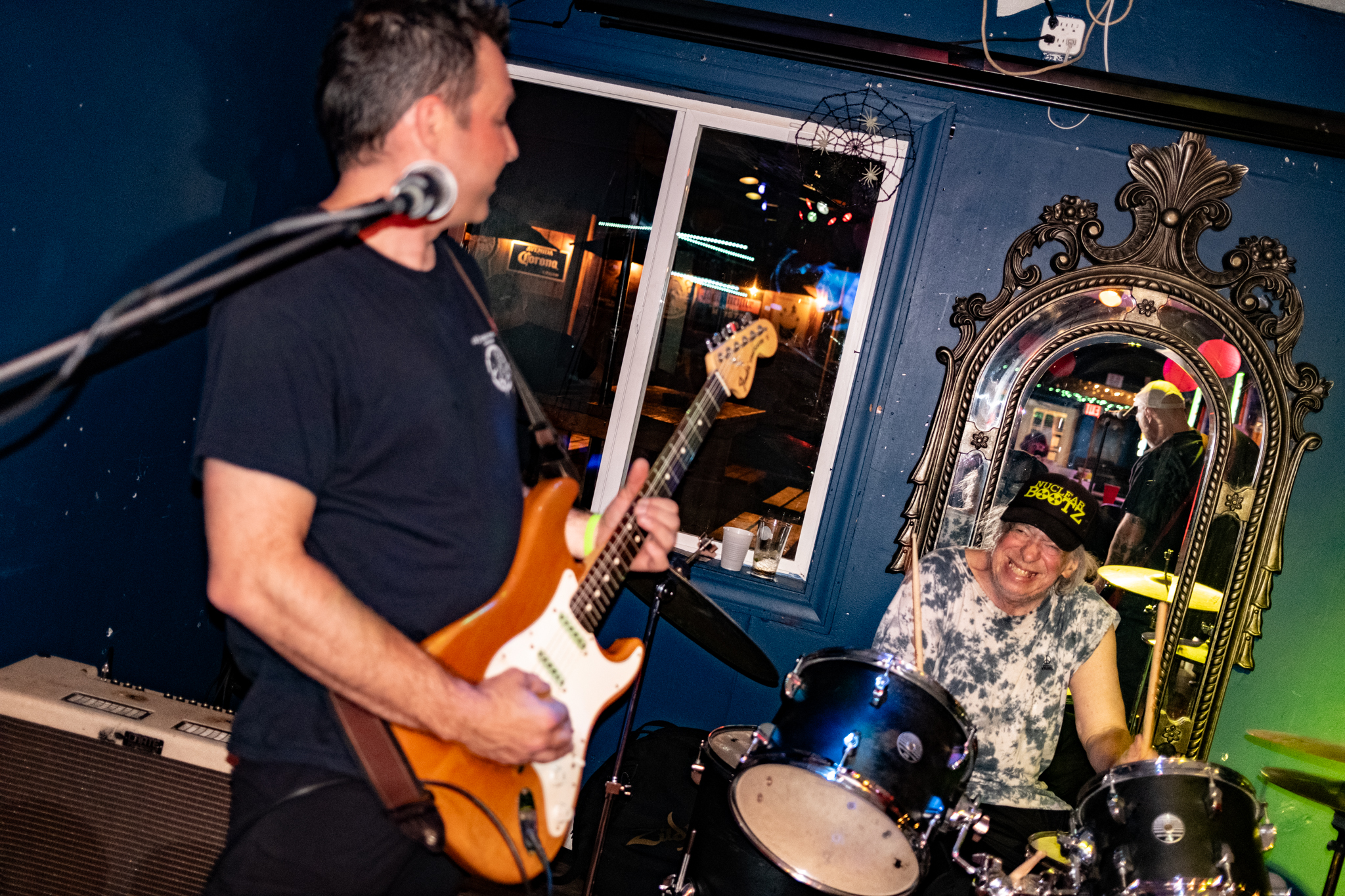
Photo by John Stafford Duncan at Sun Tiki Studios
A Personal Tribute from Will Bradford
Bruce Merson was a friend of mine. I still don't really even understand what that even means. In fact, I can't even remember the exact moment I first met Bruce, or how I ended up having a friendship with him that lasted over a decade - until the very end. I still can't explain how such a unique character could affix himself to my life, would persist in sustaining this attachment, and ultimately, claim a huge space in my heart and mind. Only now, with Bruce's passing on November 9th, is the immense magnitude of his loss finally revealed. I, alongside an army of his peers, are still trying to make sense of the event. You see, to be friends with Bruce was to engage in a friendship unlike any other in your life. There just isn't anyone like him. To say Bruce was unique would be the understatement of a lifetime. As former bandmate Gary Moore most accurately puts it, "There was never a person like Bruce Merson before him, and there will never be another person like Bruce Merson after him. He was truly one-of-a-kind."
Bruce became a regular fixture in my life when he started showing up at theWorst and SeepeopleS shows. Almost always donning his own band gear, Bruce was tireless in his efforts to network with other musicians and bands in Portland, ME and was always on the hunt for the next great gig. He was a ceaseless supporter for countless independent artists in the area, frequently championing younger bands worthy of a chance at the big time or at the least, a slot on an upcoming bill. Eventually, I found myself returning the support, and I attended a Nuclear Bootz show at Genos. I walked through the door that night uninitiated. I walked out the door later that night fully initiated and deeply inspired. To watch Bruce Merson perform music was akin to witnessing a shaman revel in deep, ceremonial catharsis - summoning wild spirits with each spiritual impulse - and setting the room ablaze with emotional chaos, ultimately cleansing us of our fear. While he was never a classically trained virtuoso by any means, as a musician, writer and performer, Bruce was the real deal. His playing, as wild as it was raw, writhed and wrestled with a primal intensity that truly felt like its own force of nature. Bruce had the rare ability to channel an entire universe into a single drum fill.
The more I got to know Bruce through the years, I came to understand that this cathartic energy he was able to summon each time he performed, ultimately, was born from a life of tragedy. Bruce's very survival depended on this primordial ritual of rebirth and his lifelong struggle to the death with his demons - his most poignant and lasting performance. The music he made during his lifetime, ultimately, the documentation of a legend. Even now, while writing this piece in a sincere effort to honor my departed friend, I find myself struggling to piece together the puzzle of this man's life, or am simply astounded on how I ended up being a very small piece in it.

In Bruce's final days I was able to conduct a short interview with him by his hospital bed, and in the days in lead up and following his passing, had the opportunity to speak with some of Bruce's close friends, collaborators, former and current band mates, all of whom I believe are also reflecting on their time spent with this true original - our sui generis. I'll do my best to tell his story as best as I know it as I believe it can teach us important things about ourselves, and our community, and it was this community, this family, that Bruce truly cherished, truly understood, and truly, truly loved
Bruce Merson was born December 14th, 1949 in Bronx, NY. His life of struggle, sadly, began in his first moments as Bruce barely survived being strangled by the umbilical cord which had become twisted around his neck during his difficult birth. It is hard to assess the impact that this event had on Bruce, but from the earliest memories of many of Bruce’s friends from New York, Bruce was always different. It is safe to say that he suffered from some modicum of mental illness - although I truly hate to use that term - that he struggled with existing in this world, and how this event physically affected Bruce’s mental state moving forward, is anyone's guess. According to Bruce, and I will revisit this later in this piece via the interview we did together in his final days, his childhood was good, and his parents supported him, purchasing him his first drum set when he was just a child helping him to begin his musical journey.
“...I learned drums from playing along to Beatles albums and records by The Who. Keith Moon and Ringo Starr were huge influences for me.” –Bruce
But it was in the storied 1970s and early 1980s NYC punk and new wave scenes that Bruce would ultimately cut his teeth in. In 1977 Bruce was playing in the Buzzie Weiler Band, performing at legendary venues like CBGBs, hobknobbing with the likes of Blondie, and even playing with The Talking Heads. As Gary Moore - amazingly born a day after Bruce at the same hospital in the Bronx - former guitarist and bandmate in the Buzzie Weiler Band and then later with WAKE UP! (as bassist), recalls, “Bruce was a regular fixture in that scene and even then, while we understood that Bruce was a bit odd, he was accepted and admired as we recognized his immense passion for music, to the point where that was his life. As a musician you have to admire it. Bruce lived, ate and breathed music, only music, and nothing else!"
Gary further ruminates,
“He was different though, there is no way to deny that, as long as I knew him he’s been that way. He wasn’t slow by any means, in fact he was extremely intelligent, quick with his wit, artistic, funny as hell and full of ideas. It’s just that he processed things differently, and certainly saw the world like no one else I have met. I remember one gig at Hunter Mountain NY - we had a residency for a bit at a venue on the mountain - a girl walked up to Bruce during intermission asking the band to play something ‘danceable,’ instead of ‘old rock 'n’ roll’. Without missing a beat, Bruce responded that ‘You just need to get into the cosmic flow!’ Bruce was always doing his best to draw you out of your world and bring him into his - and he was really good at that!”
Eventually both Gary and Bruce would leave the Buzzy Weiler Band, and taking out an ad in the Village Voice, recruited singer Sherry Dubin to join them alongside Steve Goldstein, lead guitarist and fellow Buzzie Weiler Band alum, in forming WAKE UP! (1989-1993). The band was a collaborative effort, with Bruce often arriving at rehearsals with a ready beat and some lyrics he had already written a hook too, already fleshing out the arrangement in his head before presenting it to his band mates.
“Bruce was just so easy to work with. He was such a responsive player, often playing around the other members, especially rhythmically, and always finding the most creative ways to do so,” explains Moore, a sentiment that would be similarly echoed by later collaborators. “There really was no drummer like him, ever,” he adds.
Eventually Sherry left the band to pursue other interests and in 1995 Gary played his last show with Bruce, a stressful night where Gary recalls Bruce getting in a fight with his father, who had driven him to the show, and struggled to perform that evening. Shortly after, Bruce would lose both his parents to cancer, and shortly after that, ended up homeless in New York City for a period before eventually being “shipped to Maine around 1997”, according to Bruce. It was in Portland, ME that despite enormous obstacles and challenges upon arriving, and a few years in darkness and duress, Bruce would finally gain some footing, and his mission would be renewed.
In 1999 Bruce Merson met Zeke Comparetto. The two began jamming together, on and off, for several years, even getting a rehearsal space together at Prime Artist Rehearsal Studios (now Grime Studios), but it wasn’t until 2006 that the duo started performing live together, first as The Tweeds, then Flying Duck Theory - after adding bassist Bob Bergeron - and eventually as Nuclear Boots (with an “s”), performing their first show under that moniker with Zeke’s brother Miles on bass at Genos in 2006. Over the years Justin Hyland, Chris LaFlamme, and Jim Morrissey all served stints playing bass in the band, with Morrissey settling into the longest tenure with the beloved punk band,
In 2009 the band recorded and released their debut album, Idiots in the City. Recorded with Ron Harrity in North Yarmouth, ME. The record became a local underground cult classic. Bruce’s bombastic and unpredictable drumming, combined with Comparretto’s whimsical tongue-in-pierced-cheek lyrical style, became a defining trademark of the duo’s decades-long collaboration.
“Bruce really aspired for us to be great. He wanted to achieve something historic. He took it that seriously. But when you actually worked with him, he allowed for the space to have trial, and errors. He told me we had to record every rehearsal so we could listen back to it and get better, and that we could learn the most from those errors, or mistakes. In fact, the beginning of each practice started with us listening to recordings of the last rehearsal. I thought that was brilliant, and it really made a better band”. - Zeke Comparetto
In 2013 the band released Commutathon, again with Harrity at the helm as engineer and producer. The blistering eleven track offering featured some of the band’s most memorable tracks, including “Kitty Blue”, “Don’t Need It,” and “Love is a Feeling”, a track that Comparetto always felt featured Bruce’s unexampled style of drumming best. Comparetto says
“When he was playing, Bruce seemed to just levitate, and start rising above us. He was such a powerhouse, a true classic psychedelic drummer who improvised like a jazz drummer. I never heard anyone play like that except maybe Keith Moon, who Bruce idolized."
The sophomore album was also the first released under the name Nuclear Bootz, which the band will forever be remembered as.
By 2015, the year that I got to know Bruce myself, Nuclear Bootz had long since established themselves as a raucous and wild live band and an underground secret with a small but intensely loyal fanbase. The band regularly shared the stage with acts like Big Meat Hammer and The Bumbling Woohas, and would occasionally find themselves on the front end of a metal bill as support.
“I swear the metal bands would book us to open for them - just so they could make fun of us. Bruce and I didn't care, we were happy to just play, plus, their fans always loved us anyways once we started playing!”, Comparretto fondly recalls.
In 2017, Bruce started approaching me about recording Nuclear Bootz. He had told me he really liked the first theWorst album and the SeepeopleS release that year, and that he wanted to work with me and my partner Will Holland at Chillhouse Studios in Charlestown, MA. It would be almost two years before me and the Bootz would finally truck down the road to start recording what would be the band's last recording, Green Velvet, eventually released in October of 2019. The sessions at Chillhouse were simply so much fun. Bruce initially had trouble keeping his headphones on his head during the session - he was an animal on the drums - and they kept falling off because, quite frankly, he was rocking that hard! Eventually I taped the headphones to his head (no joke, and he was kind to let me!), and we were off to the races. Nothing was going to stop this band from rocking those sessions!
“Bruce’s unwavering dedication was what inspired me to be better. Our relationship started out as a friendship, and became a brotherhood. What that meant musically was that Bruce and I were able to lock deep, and together we played through our demons.” -Zeke
The Bootz to me, were mostly a hard driving garage rock band with some punk, grunge, and classic rock tendencies, at least up until I began working with them. What I discovered was a band far more open to suggestions than I originally suspected they would be, fearless in trying out new ideas, and the sessions started to feel less like Inner Ear Studios DC (Fugazi, Bad Brains) and more like Abbey Road (Beatles). Green Velvet also features some of the band’s most recognizable songs, including the title track “Green Velvet”, “Never Change”, and Bruce’s own stated favorite, the unforgettable album opener “Cheeseburger Girl”.
I know the band, and especially Bruce, were really proud of the album. We finished it off with some guitar overdub sessions at Monaco studios in Westbrook, ME, as well as adding some Dan Capaldi percussion. The entire album was a much bigger production than I had anticipated, complete with vocal harmonies, group vocal overdubs, and even some keyboard tracks I was fortunate enough to contribute. It was during this time where the band had picked up some steam. The shows were packed and you got the sense that Nuclear Bootz as a band was finally taking flight. I even found myself on stage with the band a few times, sitting in with them. You really understood how much energy this band could move when performing live with them. Bruce to me, seemed like some fire-breathing dragon who had already kidnapped you and was whisking you off - at full dragon speed - to some far away place and you’d better hold on! Everything seemed to be ticking with stars starting to align. Then covid happened. The breath left the room.
By the time covid lockdown had ended, and shows started up, Bruce was not quite the same. Bruce’s friends had always understood that Bruce thought differently, processed emotions differently, and we had long suspected that his overall health was being deeply affected by a number of factors, even staging interventions and sometimes, seemingly, in constant conflict with Bruce’s wishes to deny or ignore whatever it was that he was suffering from. Sadly, we came to learn that one of these factors was cancer, and Bruce had been living with it for years. Long before Bruce arrived at Maine Med via the ER, it was already likely too late for him.
On December 13th, 2025, the day before Bruce’s 75th Birthday, Nuclear Bootz played its last show ever at the Apohadion Theater. Arguably still on stage at midnight for Bruce’s Birthday, the band and Bruce delivered one for the ages. It would be the last time Zeke and Bruce played a show together. Bruce’s condition began to deteriorate over the year, finally landing him in the hospital this fall, his last stop before eventually passing on November 9th. He was not alone when he passed, and I was told he set visitation records for the hospital. To say Bruce was loved - also the understatement of a lifetime.
I was there, alongside a bevy of fellow friends and musicians, Bruce’s adopted family, when Bruce received the news of his late-stage cancer diagnosis from the Doctor, but it was not until the next day that Bruce wrote on a napkin, “Is it too late for me?”, that I understood that Bruce understood. You see, you really never knew what Bruce was thinking, a sentiment shared and better explained by Zeke Comparetto.
“Bruce was an enigma. Even though I knew him as well as anyone, you really never knew what was happening inside Bruce’s head, and you were almost always going to be surprised when he finally told you what it was that he was thinking about. But, when it came to Nuclear Bootz, and as someone who struggled with depression my entire life, the music we made - well, I used it my entire life therapeutically. With the Bootz I felt like I finally had a voice to express myself. This was because Bruce gave me the confidence I hadn't had before. It was because he believed in us, and he believed in me.” - Zeke
In the week leading up to Bruce’s death, Maine Coast LIfe had approached me about connecting one of their writers with Bruce to conduct an interview. I knew that at that time it would be difficult to do so, considering Bruce’s condition. He was struggling to speak and hear in his final days, and was also becoming stressed with the amount of visitors filing through his room every day, so I offered to just write Bruce’s story from my vantage, and do my best to interview Bruce in his final days. It was a difficult and emotional interview, but even despite Bruce’s physical struggle to answer the questions, he was adamant about completing it, and I know he gave his best effort, especially considering the circumstances. I will share it with you now, and then wrap this honorarium with a few final thoughts - with what frustratingly small amount of hindsight we now have.
ME: Bruce, what music influenced you and inspired you to make music yourself.
BRUCE: ‘Sgt. Pepper’ and the Stones. Zeppelin’s ‘Physical Graffiti’ I really liked when I was a kid. ‘My Generation’ by the Who was my favorite.
ME: You’ve told me before about how big an influence he was.
BRUCE: Him and Mitch Mitchell. I really loved Mitch Mitchell.
ME: I think your drumming very much resembles his style. Certainly pertaining to what you do with Nuclear Bootz. So, is that how you started playing music?
BRUCE: Yea, At my parents house. Playing along to records.
ME: I know you were born in the Bronx, as we are both originally from there, where did you live when you started playing shows?
BRUCE: I lived in Queens NY. with my family.
ME: And who did you start playing with there? And when?
BRUCE: I started playing in 1977, then I played in a band called Mox, then The Buzzie Weiler Band, Mini Bousch and later WAKE UP! I started playing shows in 1983.
ME: You told me about the CBGB’s gig there in 1983. Is that where you played with the Talking Heads?
BRUCE: It was 1983, and it was an audition when we played with them. I was playing with Buzzie Weiler. Gary was in that band too (referring to Gary Moore, longtime bandmate).
ME: I saw a picture of you and Deborah Harry (Blondie) outside on the street in New York, I think at CBGB’s?
BRUCE: Yeah. She would hang out at their shows (Talking Heads). We all hung out at CBGBs even if you weren’t playing there. CBGB’s was it.
ME: Did you feel accepted in that scene?
BRUCE: Yea! Everyone was really supportive, They (referring to the Talking Heads again) were always supportive.
ME: Did you think back then, that they were gonna get so huge?
BRUCE: No! No! And they were weird!
ME: They were just another weird New York punk band?!?
BRUCE: Yea, Yea! I couldn’t believe it!
ME: When and why did you leave New York City? Didn’t you go to Florida?
BRUCE: 1995 or 1997. I got homeless. I went to Florida.
ME: Is this around when both your parents died?
At this moment one of Bruce’s old friends who was present in the room during this interview chimed in that he believed both of Bruce’s parents died weeks apart from each other from cancer. It has been difficult to determine exactly when this occurred, but consensus is around 1996 or 1997. I did not want to take up what little time I had with Bruce discussing his parents' deaths during this, essentially, deathbed interview, as Bruce was struggling to speak, and I also knew that personally, he preferred to not discuss certain topics. Also, getting concrete dates with absolute accuracy, when pertaining to Bruce and his often undocumented periods of his life, has been a true challenge. I did my best, and instead, let Bruce recall, as best he could, under medical duress.
BRUCE: Yes. I got homeless after that and came to Maine - I was shipped - after Florida. About 1997. I started playing with the Mutant Strains. That was the band before Bootz.
ME: And eventually you met Zeke?
BRUCE: I met him at the end of 97.
ME: Where did you first start rehearsing?
BRUCE: Grime.
ME: Wow, even then. You rehearsed there for a really long time.
BRUCE: Yea.
ME: Do you remember the very first Nuclear Bootz gig, where was it?
BRUCE: Geno’s. We were a two piece band.
ME: Just you and Zeke?
BRUCE: Yea.
ME: When did you add a bass player?
BRUCE: It was Zeke’s brother (Miles Comparetto), when we recorded. He was in the band for three years.
ME: And he was on the first album?
BRUCE: Yea, Idiots In the City. We recorded it with Ron Harrity. We did it at his house. That and Commutathon. We did both of them at Ron’s.
ME: You told me before it was a real collaboration, with you and Zeke, and he has told me the same. What is your favorite part of working with Zeke and playing in Nuclear Bootz.
BRUCE: Coming up with arrangements. Getting new songs, the development, the writing, it just made me feel good. Especially to have a new song.
ME: And you and Zeke would essentially flesh out the songs together?
BRUCE: Yea.
ME; And I know you would play songs live long before you recorded them, right?
BRUCE: We would play them live first, then play them in the studio. Ron even played bass on Commutathon.
ME: But it always started with you and Zeke together, in regards to coming up with the songs. You’ve been playing music with Zeke for twenty years now, even more. What’s your favorite part of working with Zeke?
BRUCE: You never know what he was gonna come up with. It was always really Interesting stuff, we always came up with interesting stuff.
ME: Nuclear Bootz is always interesting! (me laughing). What are your favorite Nuclear Bootz songs?
BRUCE: “Cheeseburger Girl”, “Between the Sheets,”.
ME: I always liked “Waterfalls”
BRUCE: It’s a ballad.
ME: Nuclear Bootz doesn’t have that many ballads!
ME: Through all the years, all the gigs, are there some that standout? Which ones can you best remember?
BRUCE: Apohadion album release. I remember that one. That was a good one.
ME: With the Woohas, I remember, I was at that one, that place was going berserk! And of course CBGBs.
BRUCE: Yea
ME: A lot of time passed between those gigs, 1983 and then 2019! What has changed in the music world, to you, the most?
BRUCE: Artificial Intelligence, even Autotune. especially artificial intelligence, I don’t like it!
At this point in the interview, Bruce began to slip into unconsciousness. I pledged to return to finish the interview in a couple days, sadly I never got the chance to do so. My next hospital visit would be the final one. But before I finished the interview with Bruce, I asked him if I could ask one more question and he obliged.
ME: Bruce, before I go, let me ask you - If you could tell any of the younger drummers or musicians, or anyone for that matter, who might read this - What is something truly important that they should know? Especially if they plan on doing Rock 'N’ Roll?
BRUCE: Don’t let setbacks make you quit. Never Quit. Keep it Going. Be passionate in everything that you do and Never Quit!
And with that, Bruce drifted to sleep. I suspected even then, that it was our last conversation.
A few days later on November 9th, Bruce’s body finally quit on him. For Bruce, I think when he realized he could no longer walk, then he could no longer drum, then he could, and would, no longer live. And although Bruce did live, breathe, and eat rock 'n’ roll when he was alive, and for him, music was everything, he was so much more than just a legendary musician and performer. He was a true artist, a thinker, a philosopher, a loyal friend, and especially, a magician. You see, I realize now that for Bruce, music was just a vehicle for magic, and that that magic was just love, and that Bruce was really really a legendary lover, and an even more legendary wizard of love, and that love, and loyalty, were actually everything to Bruce. And that most importantly, Rock N’Roll, was really just life, and thus really just love. Love takes patience. Love takes sacrifice. To love Bruce was to understand these things. But first, you must believe in love, life, and magic, and of course, you must believe in Rock N’ Roll.
There are so many things now, that as a friend of Bruce, I wish I could share with you. Things that would help you to understand him, but Bruce led a complicated and private life. There will be ceremonies and remembrances by the people who knew him when and then and where, and it will be their place to divulge their own personal experiences. Bruce’s story, even just his musical journey, is a difficult one to tell. Even now, I realize that I have only really alluded to the many tragedies that Bruce endured during his lifetime. That there are still looming mysteries, and sensitivities, and likely even more revelations to occur. I know I am still learning about Bruce every day. But there was one thing I understood about Bruce, and Zeke Comparetto said it best when he said “Bruce just loved life. He really did. He loved it.” And I knew that Bruce also loved love, as he lived it. He understood, of all things, the sacrifice necessary to love something or someone. To Bruce, love, life and music were one and the same, and worth every penny, every effort, every last breath.
Towards the completion of Green Velvet, sometime in the summer of 2019, Nuclear Bootz still owed me a couple hundred dollars for the recording and producing work I had done. Bruce had already paid off several installments, in person, with rolled up dollar bills at several of my gigs, cause that’s of course where I would see him. I was standing outside Sun Tiki Studios after one of these gigs when Bruce finished handing me the last of the crumpled currency on his second to last “payment”,, and said,
“Will, don’t worry, I’ll have the rest of the money real soon!”
I told Bruce not to worry at all and that I wasn’t stressing the rest of the money and he could get it to me when he was able to, at which point Bruce quickly retorted,
“It’s Ok, What’s gonna happen ? I’m not gonna pay my CMP Bill (power bill)!”
Of which I quickly responded, while laughing, to not worry about it and I said,
“Jesus dude, pay me when you can, I'm not stressing it - pay your freaking power bill!”, at this point now (and forever) with the image of Bruce sitting in the shadows in silence, not even being able to listen to his brand new album because he has no electricity for his stereo! Whatever it takes! I even knew if I asked him too, he would have sat in the dark for a month just to make sure this album came out. But far more importantly for me - I knew I was loved and respected and appreciated and that I was important to him that I knew that he saw me not just as a peer, but as a friend. I really felt the love, and it was at that very moment when Bruce poignantly replied,
“It’s Ok Will, Rock 'N' Roll can happen in the dark!”
Yes Bruce, it can, it will, and I know that right now, it most certainly is.
The official memorial service for Bruce Merson will take place Wednesday. November 25th at SPACE Gallery in Portland, ME from 3pm-6pm.
TO LISTEN TO THE MUSIC OF BRUCE MERSON:
NUCLEAR BOOTZ | NUCLEARBOOTS.BANDCAMP.COM
WAKE UP! | MIXCLOUD.COM/GARY-J-MOORE/WAKE-UP-COMPILATION
WRITER WILL BRADFORD: Friend of Bruce Merson, musician in SeepeopleS, theWorst, Sparxsea, president / owner / partner at RascalZ RecordZ, CommunityZ RecordZ (501c3), and The ARME Group.