
Through Feline Eyes - Tomás Q. Morín's new novel "Cat Love" marries animal poetry with quantum physics
By Larry Clow
Imagine a cat trapped in a box — but you can’t see in the box and the cat can’t see out. There’s a container of poison gas in there too. (Again, the cat is imaginary — don’t worry!) The gas is contained in a vial, and that vial is hooked up to a Geiger counter, which is attached to a smaller box with some radioactive stuff inside. At some point, that radioactive stuff will decay; when it does, it trips the Geiger counter, which in turn triggers the vial to open and release the gas. But as long as the box remains sealed, it’s equally likely that the cat is both dead and alive.
This is Schrödinger’s Cat, a 1935 thought experiment created by physicist Erwin Schrödinger as a way of critiquing the idea of superposition in quantum physics. Basically, an object can exist in multiple states simultaneously until that object is observed and forced into a single state. Schrödinger’s doomed (or maybe not) feline left its paw prints on various scientific and mathematical disciplines, but it also tiptoed through pop culture.
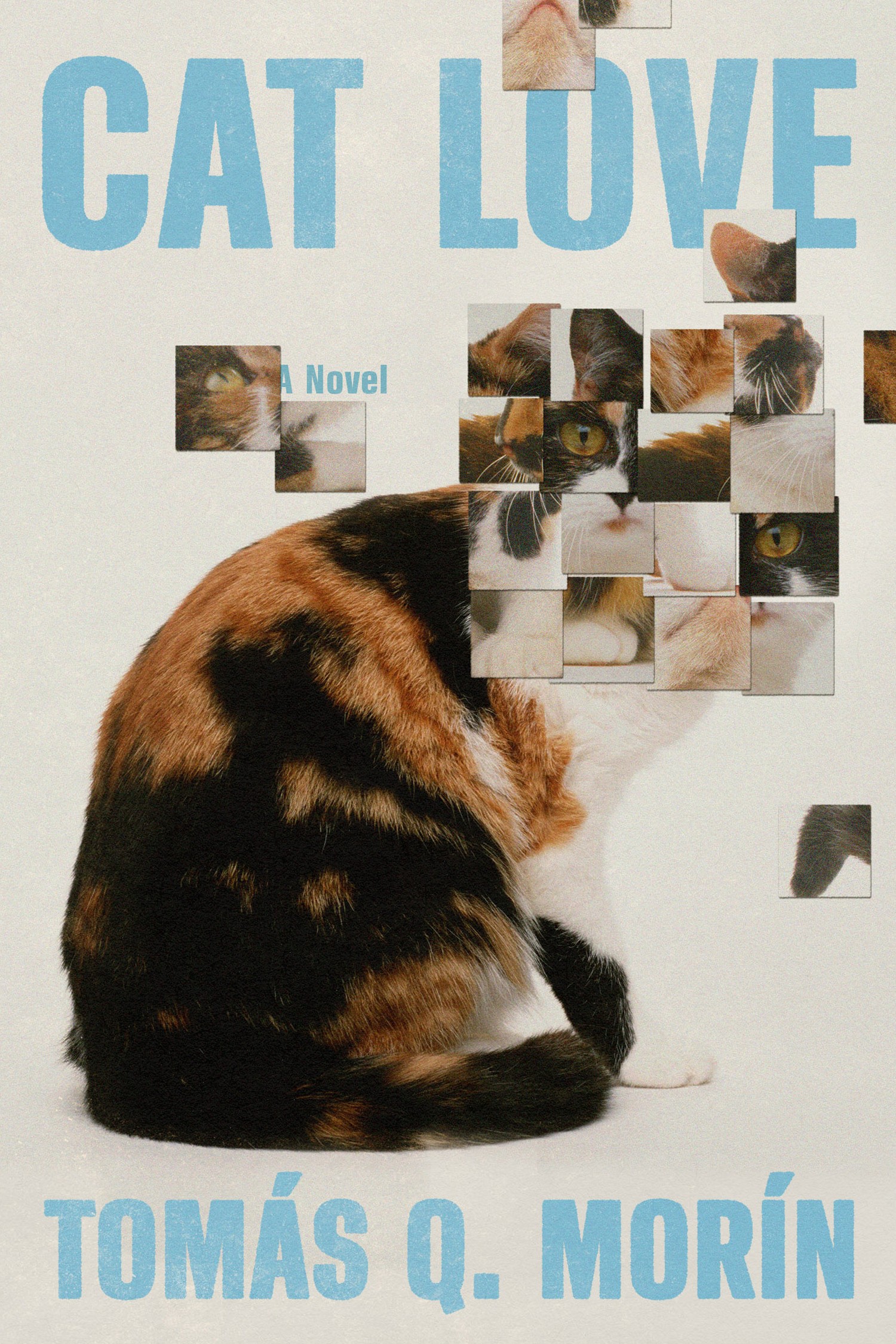
And, because Schrödinger’s cat is, well, a cat, it has a knack for showing up in unexpected places and doing unexpected things. For example: becoming the narrator of “Cat Love,” a lightly dystopian novel by Texas poet and author Tomás Q. Morín.

In the book, the feline narrator chronicles her life trapped inside a mirrored box in a lab. Humans watch her all day, as part of their training in the field of “emotional statistics,” at the end of which they will become fully qualified “emotional support humans.” The humans consider the cat’s plight (but don’t do anything about it), while the cat herself contemplates life before the box — the kittens she raised years before, her human companion (known to her as “Mustache”), and the contradictions displayed by the various people she’s encountered throughout her strange life.
The world of “Cat Love” is similar to ours; disasters both natural and man-made have changed the planet and society, and the cruelty of locking a cat in a deadly box in order to consider its plight is ostensibly a means to a greater end. Except, maybe it’s not, especially when the cat in question is witty, observant, and very opinionated about matters of art, life, and human nature.
Morín will be at Print: A Bookstore in Portland on Tuesday, July 21, to talk about the book. Maine Coast Life recently spoke with Morín about the evolution of “Cat Love,” the novel’s feline inspiration, and why his favorite fictional cat is actually a dog. This interview has been condensed and edited for clarity.
“Cat Love” brings together so many disparate elements and ideas. What was the genesis of the book?
It started with Schrödinger's thought experiment. One day, I asked myself, “What if Schrödinger's cat was real, not just hypothetical?” Which opened up a new question: if it is real … in what ways would our culture have to shift into a place where this would be acceptable? That initial question spawned these other questions and, eventually, one of the answers came into my head and I thought, “This would make a fun novel — I hope someone writes it.” [laughs] I had no training as a fiction writer … I laughed it off and, a couple days later, I heard in my head a stray bit of dialogue, and I thought, “That’s something the cat would say,” and I laughed it off again. Maybe the following week, I saw in my mind a scene … and at that point, I thought, “That would go in the cat novel,” and that’s when I started thinking of it as a novel. I’ve been writing long enough, and I’m superstitious enough, to know that if the muse gives you homework, you do it. If not, the muse gives that homework to other writers who can take on the assignment. I started recording all these stray bits in the Notes app on my phone, scenes and dialogue, for three years before I even wrote a sentence.
When did you know that a cat would be the narrator?
Two things that have always popped into my poems without planning are food and cats — they always wander in. After one of my very first readings, I ran into a stranger the next day who said, “Oh, you’re the animal poet!” … Fast forward 16 years and it seemed like, of course, the novel would have an animal narrator. “Memoirs of a Polar Bear” (by Yoko Tawada) was a huge influence and showed me how you can write an animal narrator without making it like a Brothers Grimm story or super classical. The cat was super important for me, in that sense — it felt natural.
Were you inspired by a particular cat?
Yes — Lindsey Anne Lou Sticktail Morin, the cat I dedicated the book to. Like most tortoiseshell cats, she was very sassy. … She had strong opinions and wouldn’t just jump into anyone’s lap. When she met someone new, you could tell she was immediately scanning them. I thought about her a lot, and a lot of the things Mustache and the cat narrator do — like listen to audiobooks or music together, or sitting in his lap while he watches TV — those were things we did. She was 20 when she passed away and was with me through my marriage and divorce and a lot of other life events.
In other interviews, you’ve talked about how you would physically get on the floor and look up in order to see from a cat’s point of view. How else did you get into a cat’s mindset?
For some of the moments in the book, like her opinions about Michelangelo as a painter and a sculptor, that was a riff on my own thoughts. I’ve never aired those opinions publicly, but giving them to a cat was incredibly funny and also gave them a different kind of weight. It’s not just an example of how she’s opinionated, but an example of what she loves and why. … In that moment, I took the liberty of letting her say it and giving her the confidence to do so, as if she’s also saying, “Everyone should know this” and not even think it’s a hot take, because she’s a cat and she’s always right and speaking from that level of confidence.
Early in the book, there’s a great description of a cat’s love: “Cat love is like a rainbow in the sense that, even though you can’t see the half of the rainbow that is hidden underground, you feel grateful for what your senses do allow you to take into your body.” You portray it as a force so big, it needs buffers; otherwise, it would overwhelm a person. How did you come to that idea?
A thing I’ve learned about fiction, which I’ve never experienced writing memoirs or poetry … is that I know the book is done when the characters stop speaking to me. There came a moment when I realized the cat wasn’t speaking to me anymore, and would never say anything new to me. I mention this because when I really got going on the book and the voice felt stable and steady, there were moments … where the characters take on a life of their own, and you start overhearing things. … The moment with the rainbow, it’s something that appeared on the spot and which I hadn’t thought of before. It was a surprise to me, but it felt right; it was one of those moments that felt kind of mysterious. … There were moments I needed to have the cat say things and say them with full confidence, in a way that felt like secret cat knowledge.
You’re primarily a poet. How did writing in those genres influence your fiction?
I’ve always been a narrative poet, so I have that feeling that wherever a poem starts, I have to take it somewhere that’s more than a mere observation. Sticking the landing in a narrative poem is super crucial. I thought a lot about the ways in which I use stanzas and the line to figure out my own rules for paragraphs, as discrete chunks of meaning and as a way of pacing. … The writing needed to have some bounce, to be energetic and free. The emotional statistics quizzes that serve as chapter breaks are almost like “choose your own adventure” poems that the reader can complete.
Who are some of your favorite fictional cats?
That’s a great question. The actual animal that pops into my mind is Snoopy, who’s not a cat. [laughs] When I was small, I wanted to be a comic artist, I wanted to be Charles M. Shultz. Snoopy was my favorite character — he was a dog but he could fly a plane, drive a car, and he had this complex inner life. Who knows how the soup of inspiration works, but it’s telling that you asked about a fictional cat and Snoopy was the first animal I thought of.
The idea of “emotional statistics” reminded me a lot of the philosophy of Mercerism in “Do Androids Dream of Electric Sheep?” — this idea that humans need to re-learn and actively practice empathy. Do you think that’s the case?
I think it’s always a good time to relearn how to do that. … Culturally, we’re so fragmented … and in the novel, I’m sort of poking fun at and satirizing our cultural impulse to think something to death. How we learn to empathize is by doing it, not sitting around and thinking. In the novel, I take the thinking to the nth degree. Instead of doing, characters are sitting in a classroom and staring at a box and thinking of the animal that may or may not be alive. It seems like a futile exercise, but in the world of the book, it’s okay.
Do you have a cat now?
About a year or so after Lindsey passed, I became a father. I have a 7-year-old son who’s very cat-like, and he’s been asking for a cat. I think at some point soon I’ll feel like it will be time. Since she passed, I’ve had her voice in my head in the years it took me to write the book. Now that my son is older and the book is out in the world, I can feel that space a cat usually occupies opening up.
Tomás Q. Morín will discuss “Cat Love” with Jessica Anthony at Print: A Bookstore on Tuesday, July 21, at 7 p.m.